
Slip-Resistant Rain Boots: Traction Features for Safety on Wet Surfaces
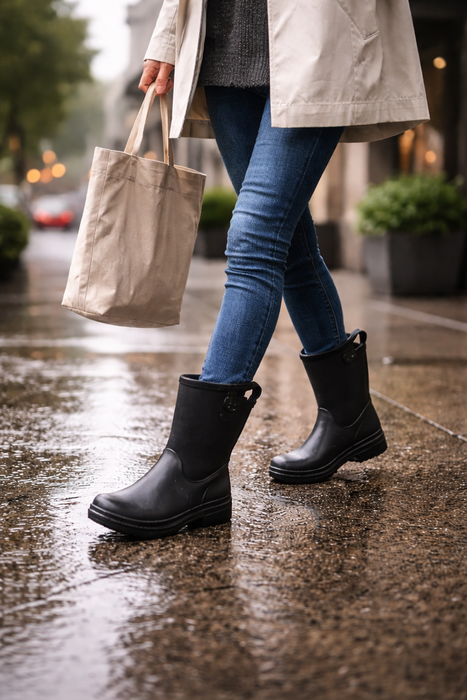
Slips and falls on wet surfaces account for millions of injuries annually, with wet weather conditions dramatically increasing the risk of accidents. Whether you're navigating rain-slicked city sidewalks, muddy trails, or slippery boat decks, the difference between staying upright and taking a dangerous fall often comes down to one critical factor: the traction your footwear provides.
Rain boots are designed to keep your feet dry, but not all rain boots are created equal when it comes to slip resistance. Understanding the science, technology, and design features that make rain boots truly slip-resistant can help you choose footwear that not only protects you from water but also keeps you safe from falls. In this comprehensive guide, we'll explore everything you need to know about slip-resistant rain boots and the traction features that make them essential safety equipment for wet conditions.
Understanding Slip Resistance: The Science of Traction
Slip resistance is measured using a value called the Coefficient of Friction (COF), which represents the ratio of the frictional force between two surfaces to the force pressing them together. In simpler terms, COF measures how much grip a surface provides.
Static vs. Dynamic Coefficient of Friction
Static Coefficient of Friction (SCOF) measures the force required to start moving a stationary object. When you're standing still on a wet surface, SCOF determines whether your feet will slip when you begin to move.
Dynamic Coefficient of Friction (DCOF) measures the force required to keep an object already in motion sliding. This applies when you're actively walking—your foot sliding across a surface as you take each step.
For footwear safety, DCOF is generally more relevant because slips typically occur while walking, not while standing still. However, both measurements provide valuable information about a boot's slip-resistant capabilities.
COF Values and Safety Standards
COF is measured on a scale from 0 (no friction, like ice on ice) to 1 (maximum friction). Here's what different COF values mean for safety:
- 0.60 or higher: Excellent slip resistance, recommended by many safety organizations for accessible routes
- 0.50-0.59: Adequate slip resistance for most applications
- 0.42-0.49: Minimum acceptable for interior wet surfaces according to ANSI standards
- Below 0.42: Increased slip risk; caution necessary
The Occupational Safety and Health Administration (OSHA) recommends a minimum SCOF of 0.5 for all walkway surfaces under both wet and dry conditions. The Americans with Disabilities Act (ADA) previously recommended 0.6 for level surfaces and 0.8 for ramps, though these specific values have been updated in favor of requiring "slip-resistant" surfaces without specifying exact measurements.
For rain boots specifically, look for products tested to meet or exceed a COF of 0.5 under wet conditions. Premium slip-resistant rain boots often achieve COF values of 0.6 or higher.
Key Traction Features in Slip-Resistant Rain Boots
Several design elements work together to create effective slip resistance. Understanding these features helps you evaluate rain boots for their safety performance.
1. Outsole Material Composition
The rubber compound used in the outsole is the foundation of slip resistance.
Natural Rubber: Provides excellent grip on wet surfaces due to its soft, pliable nature. Natural rubber conforms to surface irregularities, creating more contact points. It excels on smooth, wet surfaces like tile or painted concrete. However, it may wear faster than synthetic alternatives.
Synthetic Rubber Blends: Modern synthetic compounds can be engineered for specific traction properties. They often combine multiple rubber types to optimize grip, durability, and resistance to oils or chemicals. Synthetic rubbers can maintain flexibility in cold temperatures where natural rubber might stiffen.
Non-Marking Rubber: Formulated to leave no scuff marks on floors, non-marking rubber is essential for indoor/outdoor boots. Despite the softer composition needed to avoid marking, quality non-marking rubber can still provide excellent slip resistance.
Oil-Resistant Rubber: Some environments—commercial kitchens, industrial facilities, fishing boats—expose boots to oils, greases, or chemicals that can make regular rubber dangerously slippery. Oil-resistant rubber compounds maintain their grip even when contaminated with such substances.
Shore Hardness: Rubber hardness affects traction. Softer rubber (lower Shore A values, typically 40-60) provides better grip by conforming to surfaces but wears faster. Harder rubber (Shore A 70+) is more durable but may sacrifice some wet traction. Premium boots use multi-density outsoles with softer rubber at contact points for grip and harder rubber in structural areas for durability.
2. Tread Pattern Design
The tread pattern—the arrangement of lugs, grooves, and channels on the outsole—is arguably the most visible and important traction feature.
Deep Lugs: Protrusions on the outsole that bite into soft surfaces like mud or snow. Deeper lugs (5-8mm) provide better traction on uneven terrain. The edges of lugs are critical—sharp, defined edges maintain grip better than rounded edges.
Multi-Directional Treads: Patterns with lugs oriented in multiple directions provide traction regardless of which direction you're moving. Ladder patterns work well for forward/backward traction but may slip laterally. Hexagonal, diamond, or circular patterns offer more consistent omnidirectional grip.
Channel Systems: Grooves between lugs serve multiple critical functions. They channel water, mud, and other contaminants away from the contact surface, preventing hydroplaning. Wide, deep channels prevent clogging with debris. Precision-cut 90-degree angles at channel intersections enhance fluid displacement.
Surface Contact Area: Counterintuitively, maximizing the actual rubber-to-surface contact area (not just total outsole area) improves traction. This requires balancing solid rubber surface with adequate channeling for water displacement.
Self-Cleaning Tread: Wide, shallow channels allow dirt and debris to fall out naturally as you walk, keeping the tread ready to grip with each step. Some advanced designs incorporate specialized geometries that actively eject debris.
3. Specialized Tread Technologies
Leading manufacturers have developed proprietary tread systems that push slip resistance beyond conventional designs.
Chevron Patterns: V-shaped lugs arranged in a chevron pattern have proven exceptionally effective, particularly in marine applications. The Xtratuf Chevron outsole, for instance, has been trusted by commercial fishermen for decades. The chevron design channels water efficiently while maintaining extensive surface contact.
MaxTRAX® Technology: Patented systems like MaxTRAX® maximize outsole surface area for better traction while using precision-cut 90-degree angles to channel liquids out of the tread. These advanced designs exceed ASTM F2913-19 and ASTM F3445-21 slip-resistance standards on dry, wet, and oily/wet surfaces.
Hypergrip Square Lug Design: Square lugs with sharp leading edges scrape contamination off the floor while creating extensive contact. This proven design has been tested for decades and maximizes rubber-to-floor contact through optimized lug design and spacing.
Gladiator Tread: Designed for rugged, debris-laden environments, this pattern features widely-spaced lugs that overgrip physical debris and maintain balance on uneven surfaces. The sharp leading edges provide traction on hard, flat surfaces, while wide shallow channels promote self-cleaning.
GROUND-CTRL Rubber™: Proprietary technologies like Kamik's GROUND-CTRL Rubber combine advanced compounds with specific tread geometries engineered for superior traction and flexibility. These systems are 100% recyclable and remain pliable at extreme temperatures.
Wave-Siping™: Inspired by marine applications, siping involves cutting thin slits into rubber lugs. These cuts allow the rubber to flex and conform more closely to surfaces, increasing contact and grip. The "wave" configuration provides multidirectional flexibility.
4. Outsole Construction Methods
How the outsole is manufactured affects its slip-resistant properties.
Injection-Molded Outsoles: Heated rubber is injected into precise molds under pressure. This creates consistent tread depth, sharp edges, and exact pattern replication. The seamless bond between upper and outsole eliminates separation that could compromise traction. Injection molding allows for complex tread geometries that would be difficult to achieve through other methods.
Vulcanized Rubber Outsoles: The boot upper and outsole are assembled with uncured rubber, then vulcanized together as one unit through heat and pressure. This creates a molecular bond rather than a glued attachment. Vulcanized outsoles are exceptionally durable and maintain their integrity longer, which preserves traction over the boot's lifetime.
Direct-Attach Construction: The outsole material is applied directly to the lasted boot, creating an integrated unit. This eliminates potential delamination and ensures the tread pattern remains consistent throughout the outsole's thickness.
Multi-Density Outsoles: Advanced boots incorporate multiple rubber compounds in different zones—softer, stickier rubber in high-traction areas and firmer, more durable rubber in structural zones. This optimizes both grip and longevity.
5. Additional Safety Features
Beyond the outsole, other boot features contribute to slip resistance and overall stability.
Wide, Stable Base: A broader footprint provides more stability and increases the surface area available for traction. This is particularly important for boots designed for standing work or uneven terrain.
Heel Design: Low-profile heels with extended tread patterns reduce the risk of slips when moving backward or descending slopes. Traditional raised heels can act as pivot points that facilitate slipping.
Shank Support: An internal shank (a rigid support piece) provides arch support and prevents the boot from twisting on uneven surfaces, helping maintain stable foot placement.
Proper Boot Height: Taller boots provide ankle support that helps maintain balance and recover from near-slips. However, they should fit properly—boots that are too tall or too tight can restrict natural ankle movement needed for balance.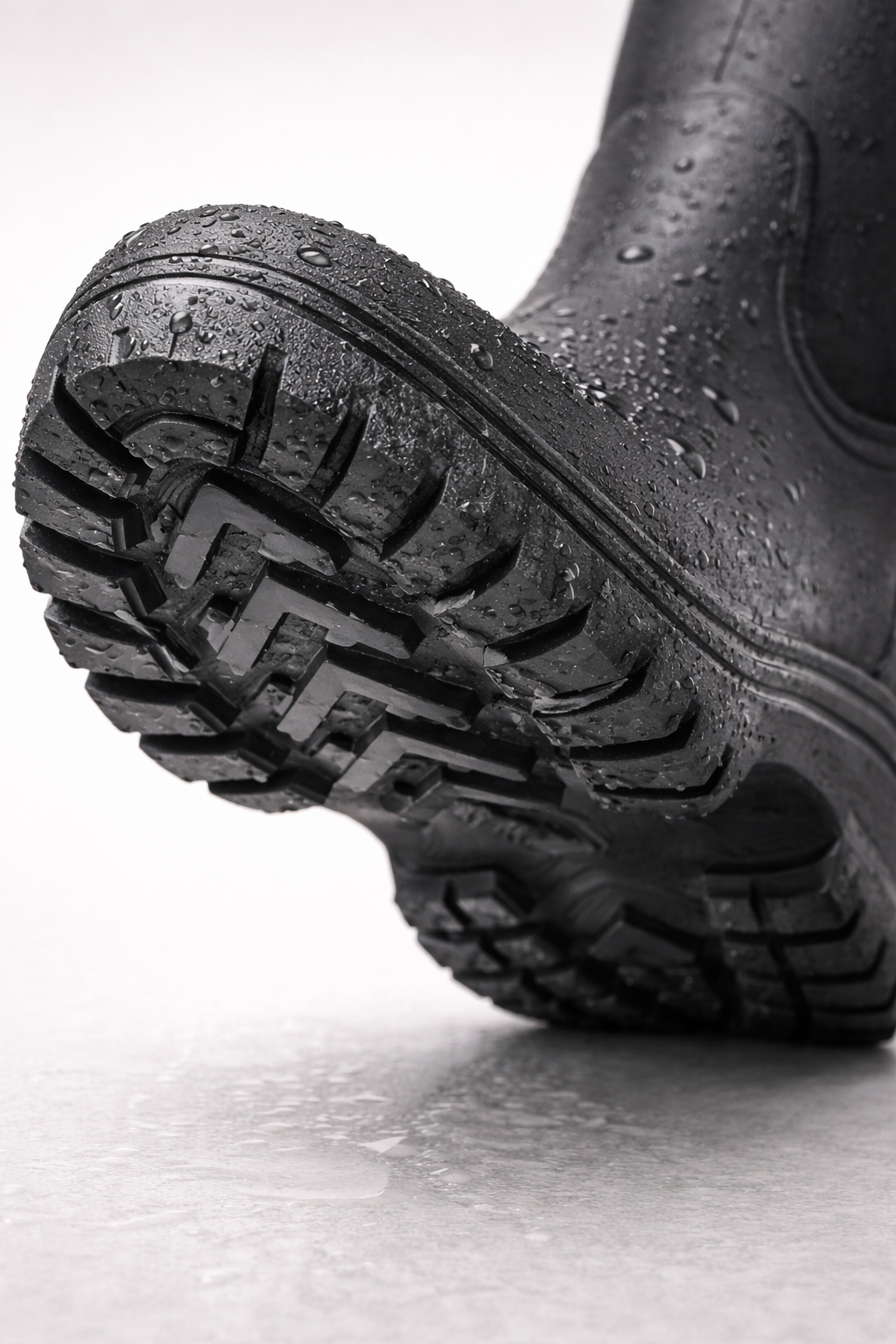
Industry Standards and Testing
Understanding testing standards helps you evaluate slip-resistance claims.
ASTM Standards
ASTM International develops voluntary consensus standards for materials, products, and systems.
ASTM F2913-19: Standard test method for measuring the coefficient of friction for evaluation of slip performance of footwear and test surfaces/flooring using a whole shoe tester.
ASTM F3445-21: Standard test method for measuring slip resistance of shoes/footwear and test surfaces/flooring using the whole shoe tribometer (WST). This newer standard is becoming increasingly important for workplace safety footwear.
ASTM F1677: Standard test method using a portable articulated strut slip tester (PAST) to measure slip resistance.
ANSI Standards
The American National Standards Institute coordinates voluntary standards development.
ANSI A137.1: Specifies that tiles suitable for interior level spaces expected to be walked upon when wet shall have a minimum wet DCOF of 0.42. While this standard applies to flooring, it's referenced in footwear contexts.
ANSI A1264.2: Standard for the provision of slip resistance on walking/working surfaces. Specifies a safety threshold of 0.50 and references ASTM testing methods.
SRC Rating
In European standards (EN ISO 20345), SRC rating indicates the highest level of slip resistance. It means the footwear passed tests on both ceramic tiles with diluted detergent (SRA) and steel surfaces with glycerol (SRB). Look for SRC-rated boots for maximum slip-resistance assurance.
Certification vs. Marketing Claims
Be aware that "slip-resistant" can be a marketing term without specific meaning. Look for boots with actual test results or certifications referencing recognized standards. Reputable manufacturers specify the testing standard used and the COF values achieved.
Environmental Factors That Affect Traction
Even the best slip-resistant boots can be challenged by certain conditions.
Surface Types
Smooth, Hard Surfaces: Wet tile, polished concrete, painted floors, and smooth stones are among the most challenging surfaces. These require boots with softer rubber compounds and tread patterns that maximize contact area.
Textured Surfaces: Rough concrete, asphalt, or naturally textured surfaces provide inherent grip that works with boot treads. However, water can still create hydroplaning conditions if not properly channeled.
Contaminated Surfaces: Oil, grease, ice, soap, algae, and other contaminants dramatically reduce traction. Oil-resistant rubber compounds and aggressive tread patterns are essential for these conditions.
Soft Surfaces: Mud, snow, wet grass, and loose gravel require deep lugs that can bite into or through the surface material to reach more stable substrate beneath.
Uneven Terrain: Rocks, roots, loose surfaces, and irregular ground require multidirectional treads and boot stability features like ankle support and shank reinforcement.
Weather Conditions
Rain: Creates thin water films on surfaces. Proper channeling prevents hydroplaning.
Snow and Ice: Require aggressive tread patterns with sharp edges. Some slip-resistant boots accept traction accessories like cleats or spikes for extreme winter conditions.
Extreme Cold: Can cause some rubber compounds to stiffen, reducing flexibility and grip. Premium boots use compounds that remain pliable to at least -40°F (-40°C).
Heat: Extreme heat can soften certain rubber compounds, potentially reducing their effectiveness, though this is rarely an issue with quality rain boots.
Selecting Slip-Resistant Rain Boots for Your Needs
Different activities and environments demand specific traction features.
For Urban Commuting and Daily Wear
Priorities: Slip resistance on smooth surfaces (sidewalks, tile, painted surfaces), style, comfort for extended wear
Recommended Features:
- COF of 0.5 or higher
- Moderate tread depth (3-5mm)
- Non-marking rubber for indoor/outdoor use
- Chevron or multi-directional tread patterns
- Ankle or mid-calf height for versatility
For Outdoor Recreation (Hiking, Camping)
Priorities: Traction on uneven terrain, mud and debris management, ankle support
Recommended Features:
- Deep, aggressive lugs (5-8mm)
- Wide channel spacing for self-cleaning
- Multidirectional tread with sharp edges
- High-traction rubber compounds
- Tall boots with ankle support
For Commercial Fishing or Marine Work
Priorities: Maximum grip on wet, oily deck surfaces, chemical resistance, durability
Recommended Features:
- Oil-resistant rubber compounds
- SRC-rated or exceeding 0.6 COF
- Proven tread patterns like Chevron or Xtratuf Legacy
- Seamless or vulcanized construction
- Reinforcement in high-wear areas
For Commercial Kitchens or Food Service
Priorities: Slip resistance on wet, greasy floors, easy cleaning, non-marking soles
Recommended Features:
- Oil and slip-resistant certification (ASTM F2913 or F3445)
- Non-marking rubber
- Minimal tread depth to prevent debris accumulation
- Easy-to-clean design
- Waterproof for constant wet conditions
For Healthcare or Indoor Work
Priorities: Slip resistance on smooth, often polished floors, quiet operation, professional appearance
Recommended Features:
- High COF on smooth surfaces (0.5+)
- Non-marking soles
- Lower-profile treads that don't track debris
- Slip-on or easy-closure designs
- Waterproof for spill protection
For Construction or Industrial Work
Priorities: Multi-surface traction, puncture resistance, durability, safety compliance
Recommended Features:
- ASTM F3445 certification
- Oil and chemical-resistant compounds
- Deep, aggressive tread for varied terrain
- Reinforced construction
- Potentially steel toe or metatarsal protection
Maintaining Slip-Resistant Properties
Proper care preserves traction over the boot's lifetime.
Regular Cleaning
Debris, oils, and contaminants embedded in tread grooves compromise slip resistance. After each use, rinse boots thoroughly to remove mud, dirt, and other materials. For stubborn contamination, use a brush to clean between lugs and in channels. Avoid petroleum-based cleaning products that can degrade rubber and reduce grip.
Inspect Tread Wear
Regularly examine the tread depth and pattern. As treads wear down, traction decreases. Most slip-resistant boots have wear indicators or visible patterns that show when replacement is necessary. Generally, when tread depth has decreased by 50% or more, consider replacing boots.
Replace boots when:
- Tread depth is significantly reduced
- Edges of lugs are rounded rather than sharp
- Rubber feels hard or inflexible
- Visible cracks appear in the outsole
- Boots have become slippery despite cleaning
Proper Storage
Store boots away from direct sunlight, extreme heat, and ozone sources (electric motors). These factors degrade rubber compounds, potentially hardening them and reducing flexibility and grip. Use boot shapers or stuff with paper to maintain shape and allow air circulation.
Avoid Damaging Surfaces
Walking on extremely rough surfaces (gravel, sharp rocks) or abrasive materials accelerates tread wear. While slip-resistant boots are designed for durability, minimizing unnecessary exposure to abrasive conditions extends their life and maintains traction.
Conditioning and Treatment
Some rubber boots benefit from periodic application of rubber conditioners that restore flexibility. Follow manufacturer recommendations. Avoid silicone-based treatments on slip-resistant outsoles as they can reduce traction.
Common Slip-Resistant Technologies by Brand
Understanding what different manufacturers offer helps in selection.
BOGS: Features BioGrip™ anti-slip outsoles with self-cleaning tread patterns. Their boots use molded rubber construction for consistent traction and durability. Best for moderate slip resistance in everyday wet conditions.
Kamik: Incorporates GROUND-CTRL Rubber™ technology that remains flexible to -58°F and provides superior traction through specially engineered tread patterns. Multi-directional treads channel water effectively. Excellent for varied outdoor conditions.
Xtratuf: Known for the legendary Chevron outsole pattern that's been proven in Alaska's commercial fishing industry. SRC-rated slip resistance with exceptional performance on oily and wet surfaces. The gold standard for marine applications.
Muck Boot: Arctic Grip and other proprietary outsoles designed for extreme cold and varied terrain. Deep lugs and aggressive patterns for mud and snow traction.
Shoes For Crews: Specializes in slip-resistant workplace footwear with Hypergrip and Gladiator tread designs. Consistently achieves high COF scores. Ideal for professional kitchen and food service environments.
The Real-World Impact of Slip-Resistant Rain Boots
The importance of proper slip-resistant footwear extends beyond comfort to genuine safety.
Falls on wet surfaces result in approximately 1 million emergency room visits annually in the United States alone. The Bureau of Labor Statistics reports that slips, trips, and falls account for 15% of all accidental workplace deaths and are the second leading cause of workplace fatalities. A significant portion of these incidents occur in wet or contaminated conditions where proper slip-resistant footwear could have prevented the accident.
For professionals working in high-risk environments—commercial fishing crews, kitchen staff, healthcare workers, construction teams—slip-resistant rain boots aren't just a convenience; they're essential safety equipment that can literally be lifesaving.
Even for everyday use, the confidence that comes from secure footing in wet conditions has practical benefits. You can navigate rainy days without hesitation, maintain normal walking speed rather than dangerously short shuffling steps, and focus on your destination rather than worrying about each step.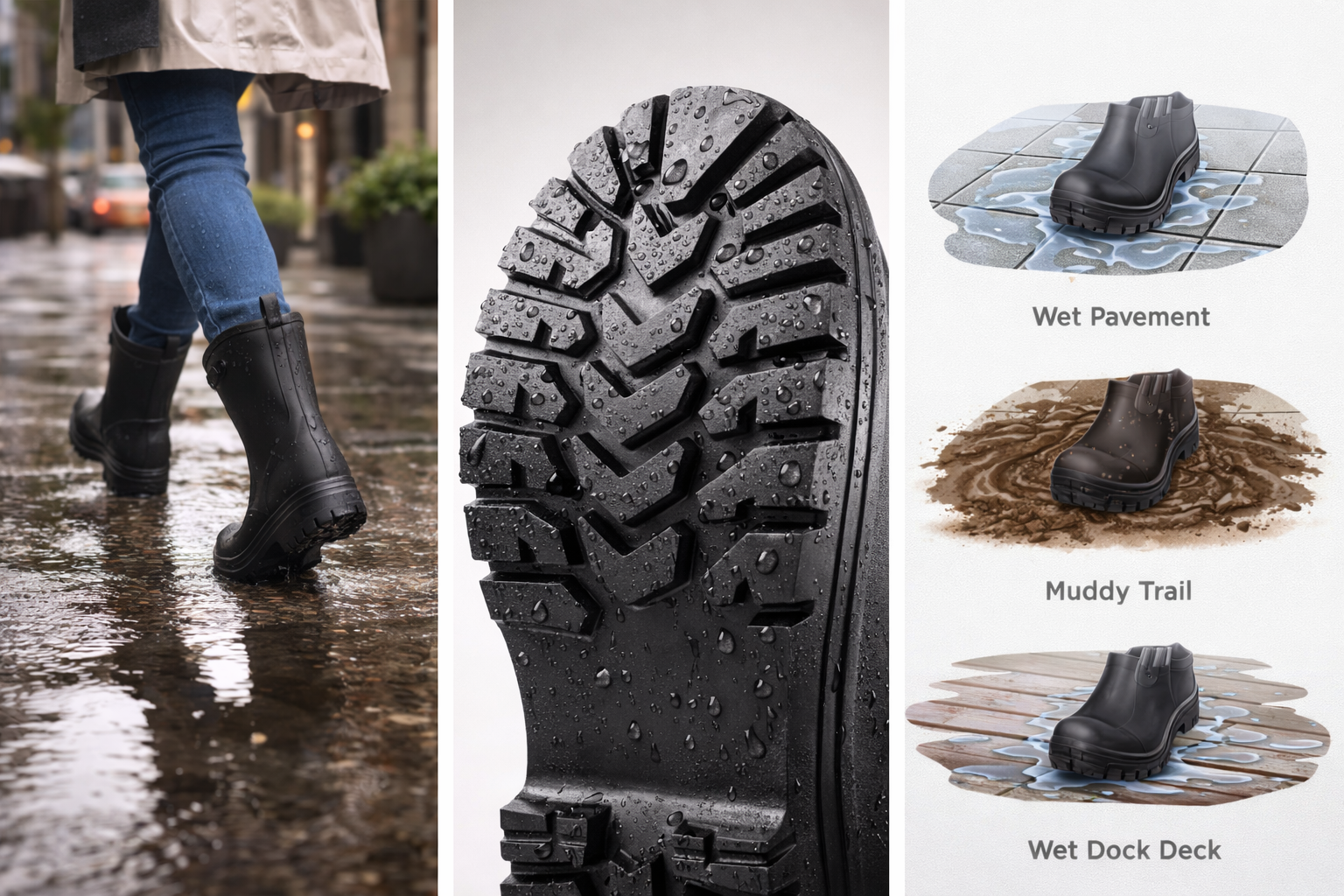
Conclusion: Investing in Safety and Confidence
Slip-resistant rain boots represent the intersection of materials science, engineering design, and practical safety. The traction features we've explored—advanced rubber compounds, precision-engineered tread patterns, proven construction methods, and rigorous testing standards—work together to keep you safe on wet surfaces.
When selecting rain boots, look beyond basic waterproofing to evaluate their slip-resistant capabilities. Check for specific COF ratings, recognize quality tread patterns, understand the testing standards referenced, and match the boot's features to your intended use. Remember that "slip-resistant" is most meaningful when backed by actual test results and certifications.
Proper slip-resistant rain boots provide more than physical protection; they provide confidence. The security of knowing each step will find purchase on wet surfaces allows you to move naturally and safely, regardless of weather conditions.
Whether you're commuting through urban rain, working on slippery decks, hiking muddy trails, or simply need reliable footwear for unpredictable weather, investing in genuinely slip-resistant rain boots is an investment in your safety and peace of mind.
Ready to experience the security of truly slip-resistant rain boots? Explore Schreter's collection of women's rain boots featuring premium brands like BOGS, Kamik, and Xtratuf—each incorporating proven traction technologies designed to keep you safe on wet surfaces. Our curated selection ensures you'll find rain boots engineered with the slip-resistant features that matter most for your specific needs.
Don't let wet weather slow you down or put you at risk. Step confidently into any conditions with rain boots built on a foundation of scientifically-proven traction and real-world safety performance.